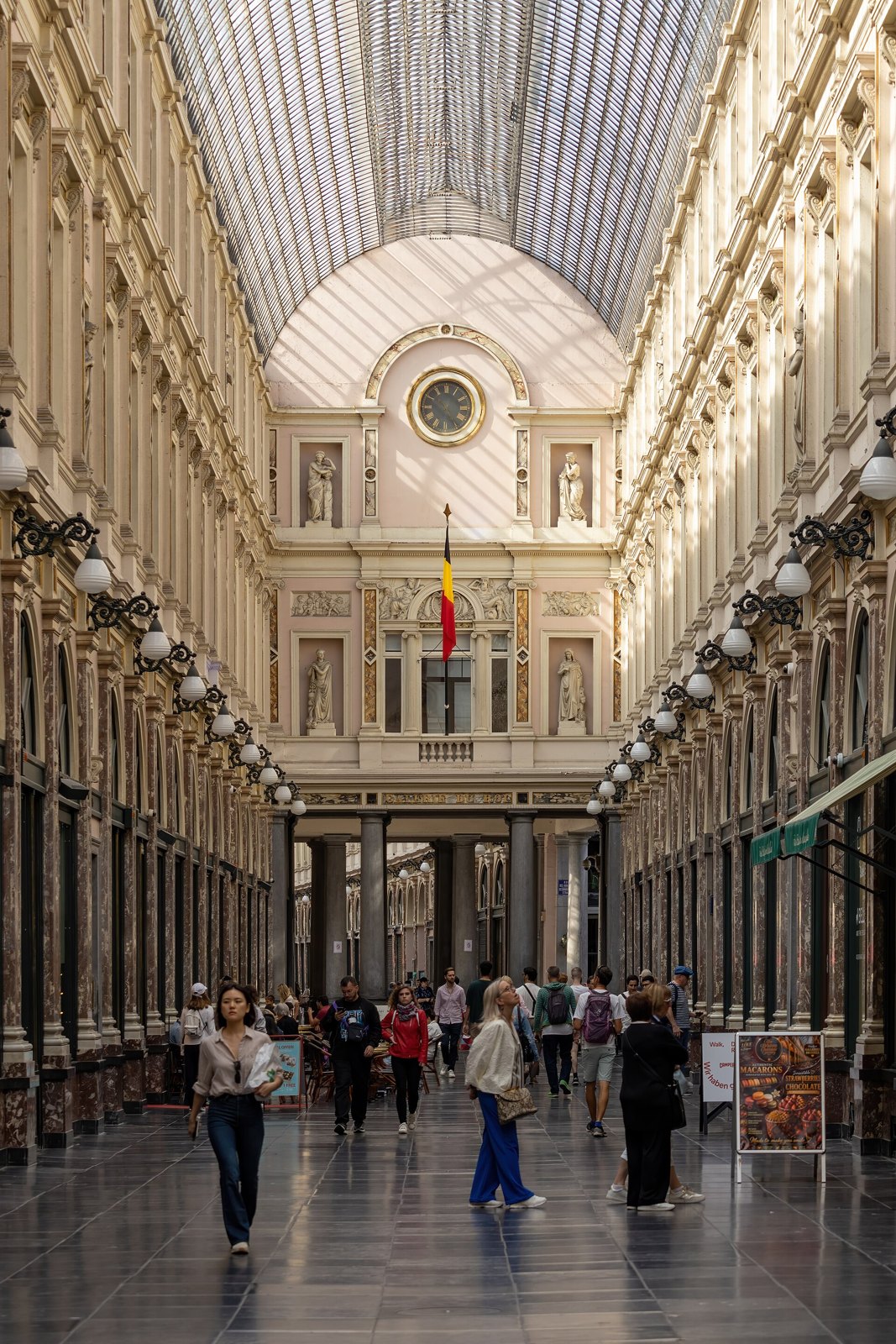
Brussels center sits in a valley, and the old street plan still shows it. A lower town runs along the former Senne river, a upper town sits on the ridge above it, and the two are separated by a drop of roughly 30 meters. Two free public lifts, run by the City of Brussels, cut that climb entirely.
How is Brussels actually split into an upper town and a lower town?
The lower town is the medieval core, built along the river and around the Grand-Place / Grote Markt. The upper town is the ridge to the east, where the dukes and later the Austrian governors built their palaces. Between them is a steep slope, covered in places by stairs and in others by one long climb.
Most visitors cross it at Mont des Arts / Kunstberg, the terraced garden and staircase built for the 1958 World’s Fair. It frames a well-known view down toward the Grand-Place’s spires. The staircase works. It is also long, exposed to full sun, and not an option for a wheelchair, a stroller, or a heavy suitcase.
Few guides mention the alternative: two free public lifts, open to anyone, built into the hillside itself. Used with the stairs or the metro, they turn the upper-lower split into a loop, not a wall.
What are the free public lifts, and why do they exist?
They are passenger elevators owned and maintained by the City of Brussels. Both are free. No ticket, no STIB card, no barrier.
They exist because the ridge separates neighborhoods that function as one city. Residents of the Marolles / Marollen need to reach the Palais de Justice level for work, transit and shops every day. The City treats that connection as basic infrastructure, not a tourist amenity, and the regional tourism body, visit.brussels, lists both among the city’s accessible routes.
That framing matters for planning. These are not attractions with opening-time drama built in. They are public transport infrastructure, like a bus shelter. Confirm current hours on the City of Brussels’ own site before building a day around either one, since both close overnight and occasionally go out of service for repair.
How do the two lifts link into one continuous walk?
Used in sequence, the two lifts let a visitor walk from the Marolles flea market to the Grand-Place while crossing the ridge twice, for free, and never on stairs. The route below runs north. It works just as well in reverse.
| Lift | Connects | What it replaces | Hours |
|---|---|---|---|
| Ascenseur du Palais de Justice / Lift Justitiepaleis | Rue des Minimes, in the Marolles, up to Place Poelaert / Poelaertplein | The steep streets and long stair climb between the Marolles and the Palais de Justice esplanade | Free, daily; published by the City of Brussels — confirm current hours before relying on them |
| Treurenberg lift (near Gare Centrale / Brussel-Centraal) | Rue Treurenberg, behind the Cathedral of St. Michael and St. Gudula, down to the Putterie / Gare Centrale level | The stepped streets between the cathedral ridge and the lower town near Gare Centrale | Free, daily; published by the City of Brussels — confirm current hours before relying on them |
- Start at Place du Jeu de Balle / Vossenplein, in the Marolles, where the flea market runs every morning of the year.
- Walk up Rue des Minimes to the lift at the base of Place Poelaert. It opens directly onto the esplanade in front of the Palais de Justice.
- Cross Place Poelaert — the view back over the Marolles rooftops is the payoff for skipping the climb — and continue toward Sablon / Zavel.
- From Sablon, walk north through the upper town, past the Royal Palace quarter, to Mont des Arts / Kunstberg.
- At the cathedral end of Mont des Arts, follow Rue Treurenberg to the second lift. Ride it down to the Putterie level, near Gare Centrale.
- From there, it is a short, flat walk to the Grand-Place / Grote Markt.
UNESCO’s World Heritage List includes the Grand-Place, inscribed in 1998 for its guild houses and its Gothic Town Hall. That is the walk’s natural endpoint, and the full World Heritage List entry is a checkable source for why.


What do the lifts actually save you from climbing?
The Palais de Justice lift replaces a genuinely steep section. Rue des Minimes and the surrounding Marolles streets climb toward Place Poelaert at a gradient that is uncomfortable on foot. With luggage, or with a wheelchair, it is worse. The lift resolves that in under a minute.
The Treurenberg lift does something similar on a shorter but still real slope, between the cathedral ridge and the Gare Centrale level. Visitors heading from the upper town to a train at Gare Centrale otherwise face a stepped street with no handrail-free option.
Both lifts matter for luggage specifically. A visitor walking from a hotel in the upper town toward a train, or the reverse, can avoid hauling a case down a staircase. For other ways to avoid carrying bags around the city center, see the guide to left luggage in Brussels’ stations.
What happens if a lift is out of service?
Public elevators break down. Brussels’ two are no exception, and there is no published guarantee of year-round availability for either. If one is closed, the fallback is the stairs it was built to bypass — or the metro.
Brussels’ underground network already tunnels through this same ridge. Lines 1 and 5 run through a stretch originally built as a tram premetro, and a single stop on them crosses the slope with no climbing at all. The shared tunnel’s history is explained in the guide to why a Brussels premetro stop looks like a metro station.
A metro or tram ride here uses the same STIB ticket as anywhere else in the city center. There is no separate fare for crossing the ridge underground. How that ticket is structured, and what it covers, is explained in the guide to how a STIB ticket works.

What else sits along this route?
The walk between the two lifts passes several buildings worth knowing by name, not just by view.
- The Palais de Justice / Justitiepaleis, designed by Joseph Poelaert and completed in 1883, is one of the largest courthouse buildings raised in the 19th century.
- Sablon / Zavel holds the Gothic church of Notre-Dame du Sablon / Onze-Lieve-Vrouw-ten-Zavel and a long-running antiques market.
- Mont des Arts / Kunstberg sits above the Coudenberg site, the buried remains of the palace that stood on this ridge before a fire destroyed it in 1731.
- The Cathedral of St. Michael and St. Gudula stands directly above the Treurenberg lift, at the point where the upper town drops toward Gare Centrale.
Several museums cluster around Mont des Arts, including the Royal Museums of Fine Arts and the Magritte Museum. Like most Brussels museums, they close on Mondays. That pattern is covered in the guide to what shuts in Brussels on Mondays, and which museums on this route are free on a given day is covered separately in the guide to which Brussels museums are free, and on which days.
Why do some street names here look doubled?
Brussels is officially bilingual. Every street, square and commune on this route has a French name and a Dutch one. Place Poelaert is also Poelaertplein; Mont des Arts is also Kunstberg. Neither is a translation of convenience — both are official, and signage generally shows both. When it actually matters which one a reader uses is explained in the guide to which language to use in Brussels.
When is this walk at its quietest?
Place Poelaert and Mont des Arts both draw crowds around midday in warmer months, mostly for the view. Early morning is quieter at both. The Jeu de Balle flea market at the Marolles end is already running by then; it opens every morning of the year, with no closed day. Seasonal patterns across the city, including when the upper town fills up, are mapped in the Brussels crowd calendar, month by month.
Access Brussels is an independent guide written from published, checkable sources. We have not visited the places described here and we do not publish personal recommendations or invented ‘local favorites’ — where something is singled out as notable, we say who says so. Opening times, fares, closures and prices change at short notice, so treat everything here as a starting point and confirm with the museum, operator or venue directly before building a day around it. We give no advice on visas, insurance, health or safety; use your own government’s official guidance for those.
Featured image: Photo by iMahesh, source, CC BY-SA 4.0
